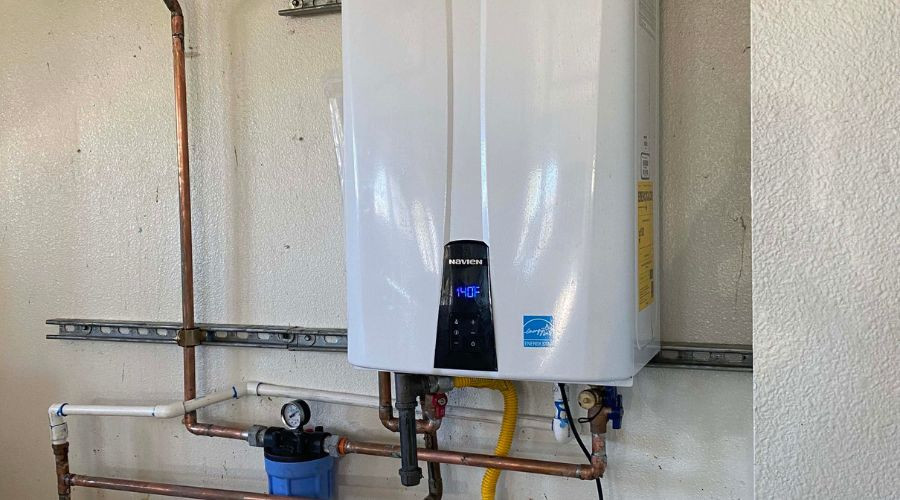
A standard tank water heater burns around 40,000 BTU/hr. A whole-house gas tankless unit burns up to 199,000 BTU/hr, close to five times as much, because it heats water on demand instead of keeping a tank hot. That jump is why a line that fed the old tank fine can starve a tankless unit.
Turn BTU into a gas demand you can size
Natural gas carries roughly 1,000 BTU per cubic foot, so a 199,000 BTU/hr unit needs about 199 cubic feet per hour (CFH). Propane packs more energy per cubic foot (~2,516 BTU/ft³), so the same heater draws only about 79 CFH of propane. Sizing works on that CFH demand, not on the BTU number directly.
Length decides the answer
A pipe's gas capacity drops as the run gets longer, because friction eats the available pressure. Sizing uses the longest-length method: measure the developed length from the meter to the farthest appliance, then size every section for that length. For 3/4-inch Schedule 40 steel on a standard 0.5" w.c. drop:
- At 10 ft, 3/4" carries roughly 360 CFH, plenty for 199 CFH.
- At 40 ft, that same 3/4" is down to about 170 CFH, short of 199.
- At 40 ft, stepping up to 1" restores about 320 CFH (enough, with margin).
So the honest answer to "do I need a bigger line?" is: it depends on how far the heater is from the meter. A short run may hold on 3/4"; a typical 40–60 ft run usually needs 1".
Also check the meter and the branch, not just the pipe
Pipe sizing assumes the gas is actually available. Confirm the meter and service regulator can deliver the total connected load. A common surprise on tankless retrofits is a meter that maxes out before the pipe does. For long or fully loaded runs, a 2 psi system with a line regulator at the appliance is often the cleaner fix than oversizing everything.